
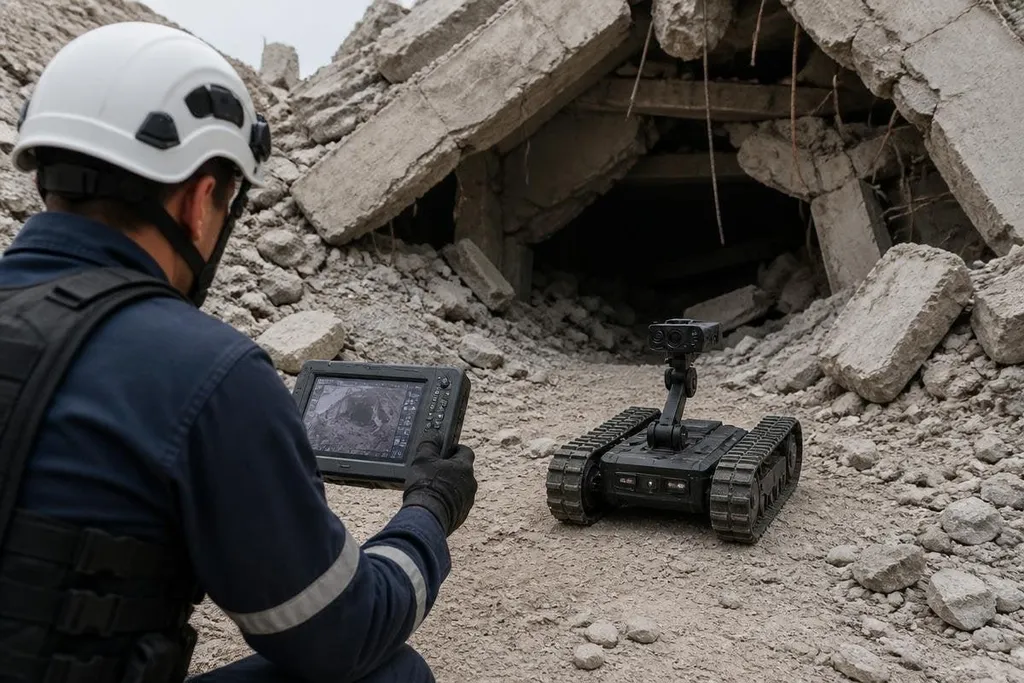
A rescue robot can enter a damaged building, inspect a hazardous area, or carry a camera where a person should not go first. Its value comes from distance: the operator can gather information before sending people into danger.
This article looks at how these machines work, what they can do during a rescue, and where their limits still matter.
- Remote inspection: cameras, microphones, thermal sensors, and LiDAR can show conditions from a safer position.
- Difficult terrain: tracked, wheeled, and legged robots can move over surfaces that are unsafe for a person.
- Human control: many rescue tasks still depend on an operator who can judge changing conditions.
What rescue robots do first
The first task is often inspection. A robot can carry a camera through smoke, rubble, narrow spaces, or unstable structures while the operator remains outside the danger zone. The video can show blocked paths, damaged floors, open doors, or people who need help.
Thermal cameras add another layer of information. They detect heat rather than ordinary light, which can help an operator search a dark space or identify a warm object behind some materials. The sensor does not prove that a person is present, so trained teams still need to check the result.
LiDAR measures distance with pulses of light and builds a map of nearby surfaces. That map can help the operator judge gaps, walls, and routes. Dust, smoke, reflective surfaces, and blocked views can still reduce what the robot sees.
Machines for different rescue work
Tracked robots are useful when a machine needs grip on broken ground. Wheels can give higher speed on firm floors, while legs can step over some obstacles. The choice depends on the surface, the robot's size, its battery, and the weight of its sensors.
A robot may also carry a two-way radio, a loudspeaker, a microphone, or an arm. These parts change the task from looking to communicating or moving a small object. A robotic arm can open a door or clear light debris in some settings, but it cannot replace a full rescue crew.
Many systems use teleoperation, which means a person sends movement commands from a remote location.
Autonomous functions can help with mapping, obstacle detection, or route control, yet the operator remains responsible for the wider situation. A machine may detect a wall without understanding that the wall could collapse.
A rescue robot can map a collapsed building and still fail when smoke blocks its cameras or rubble traps its wheels. The test site, control link, task, and failure point matter as much as the map on screen. Reports at Robot24 can tie rescue-robot claims to those details before the article turns to where the machines lose ground.
Where the limits appear
Rescue sites are hard on machines. Water can damage electronics, dust can block sensors, and broken concrete can trap wheels or tracks. Radio signals may weaken inside buildings, underground spaces, or areas filled with metal structures.
Battery life also changes the plan. The robot may need a return route, a spare battery, or a cable that carries power and data. A machine that stops inside a damaged building creates another problem for the team that sent it there.
The operator faces limits too. Video delay can make movement slow and risky. A camera may show a doorway without showing the floor below it. A map can help with direction while hiding the fact that the surface is unstable.
I'd treat any claim that a robot saves lives as a claim that needs a named mission, a date, and a measured result.
A field decision guide
Before a rescue team sends a robot into a hazard, check these points:
- Task: define the question the robot must answer, such as “Is the passage open?”
- Sensors: confirm that the camera, thermal sensor, microphone, or LiDAR fits the site.
- Link: test radio range and plan what happens if the signal drops.
- Power: set a return point before the battery reaches its limit.
- Recovery: prepare a way to retrieve the robot if it tips, stalls, or loses contact.
- Handoff: decide who turns the robot's findings into a rescue action.
That last point matters because the machine produces information, while people decide what to do with it. A rescue robot earns its place when it answers a useful question without adding a new hazard.
The next measure is clear: teams need mission records that show where the robot went, what it found, what failed, and whether people reached the site more safely.